Showing posts with label Chicago Cubs. Show all posts

Wednesday, November 30, 2016

#335 Steve Henderson Chicago Cubs

Man there is a lot happening on this card. First of all we see Steve Henderson bunting in a batting cage.  The bat has tape around the barrel which isn't something you often see on cards.  We have a tire from the rolling cage and the rarest find is what I think is a camera man on the left with blue jeans. How often do you see someone in jeans on a baseball card?  
Also Henderson's badass mustache is readily visible in the inset.  
Anyway, this is Henderson's sixth Topps card.  He would appear on ten base cards in his career from 1978-'88, with Topps omitting him from the '87 set.  


Player: Steve was one of three unrelated Henderson's to play OF in the 80's which I always found confusing (more on that later). He got his start in the Reds chain when he was drafted in the 5th round in 1974.  Henderson would find himself in the headlines before he made the majors when he was dealt with three others to the Mets in the July 1977 Midnight Massacre deal that sent Tom Seaver to the Reds.

The Mets immediately put him on the roster and despite the Big Apple pressure after the very-unpopular trade, Henderson batted .297/.372/.480 in 99 games.  The impressive showing allowed him to finish 2nd in National League ROY voting to Andre Dawson.  At one point Mets skipper Joe Torre claimed that "Someday the Seaver trade will be referred to as the Henderson trade".

The young leftfielder played nearly every day in 1978 but his batting average dipped to .266 and his slugging went down to .399.  Despite good speed he had a penchant for killing rallies with a league leading 24 double plays.  

Henderson rebounded in '79 batting .306/.380/.480 before an injury sidelined him in July for all but one game at the tail end of the season.  He returned to everyday status in 1980 and batted a respectable .290 and swiped 23 bases. 

Prior to the '81 season the Mets dealt Henderson and cash to the Cubs for Dave Kingman. Henderson played well for his new team batting .293 with a .382 on base percentage.  The '82 season saw him him slump early and his average hovered around the Mendoza line for most of the summer.  A blazing August (.337 average) helped salvage the season a little, but he still ended up batting a career worst .233.

The Cubs traded Henderson to the Mariners after the season for Rich Bordi and Henderson would have one more season as a regular and did OK batting .294 with 10 HR and 10 SB.  Henderson's days a regular disappeared as the Mariners outfield became crowded with veterans Barry Bonnell, Al Cowens, Gorman Thomas and youngsters Dave Henderson and Phil Bradley.  Henderson again put up moderate production with 10 HR and in 364 plate appearances.

Henderson, by now 32 years old and a free agent signed a deal with the A's in '85 and batted .301 as the right-handed half of a platoon with Dave Collins.  After just two hits in 26 at bats to start the '86 season the A's released him.  He latched on with the White Sox but had to swallow his pride and play at AAA Buffalo the rest of the year.

Henderson found himself without a team in '87 but hooked back up with the A's franchise playing the first half of the year at AAA Tacoma.  He was called up mid-year and was a 5th outfielder behind Jose Canseco, Dwayne Murphy, Mike Davis, and Luis Polonia.  Henderson did alright batting .289 in 126 plate appearances.

The following spring he signed with the Astros and split the year between the parent club and AAA Tucson.  His .217 average, lack of power, and diminishing speed did little to convince anyone to keep him around and that would be his last season in the majors.  

Henderson played all of '89 in AAA ball for the Pirates and spent the next two winters in the Senior Professional Baseball League before calling it a career.


Flipside:  The '82 season was the first real stinker of his career.  He finished the year in a 1 for 23 funk.

Oddball: Steve was definitely the least popular Henderson of the three outfielders with that surname in the 1980's.  Of course Rickey is the Hall of Famer and everyone knew Rickey but Dave Henderson and Steve were for a long time like a whole different category Henderson.  Of course Dave later made a name for himself in the playoffs for the Red Sox in '86 and later part of the powerful A's teams.  But geez check out the chart below...teammates in Seattle for a while, both later on the A's, neither of them Rickey. No wonder I couldn't keep them straight.


History:   Henderson's career started with a lot of promise and although he went on to play 12 seasons the 12 HR and .852 OPS he posted as a rookie would prove to be career highs.  At first glance the stats for Henderson can look more positive than you would expect.  A career 114 OPS+, a .280 BA and .352 OBP aren't too shabby but some digging revealed some weaknesses in his game.  Perusing the scouting reports on him from the 1980's most pointed out that he had trouble with inside fastballs.  Once that became apparent pitchers attacked him there.  He was fast but the raw talent didn't translate to the basepaths as he had several seasons where he was caught stealing more times than he was successful.  Despite his speed,  Henderson was considered a liability in the field which further hurt his chances to play everyday.  
Although he may not have lived up to the potential that many thought he had, Henderson still had a nice career.
Since his playing career ended Henderson has been a coach at many different stops.  He was recently let go from his hitting coach position with the Phillies.

Sunday, February 3, 2013

#305 Larry Bowa - Chicago Cubs

Veteran Larry Bowa is shown here on his 14th Topps card.  We had a great streak of action shots going but now we've seen three posed pictures in a row.  But hey, if you like choking up on the bat, batting gloves, or curly hair overflowing from a player's hat, then this is the card for you.

PlayerLarry Bowa was playing ball at Sacramento City College when he caught the attention of Philadelphia scouts and was signed as a free agent in October of 1965.  Even though he went undrafted and was cut twice from his high school team, Bowa advanced all the way to AAA in his first year of pro ball.
 
Bowa made the team in 1970 as the Phillies starting SS and got off to a very slow start hitting under .200 for the first two months of the season.  The Phils stuck with their slick fielding rookie and he improved to .250 by the end of the year.  Bowa was definitely all glove as he had only 23 extra base hits and 21 walks.
 
The next two years Bowa hit .249 and .250, led the NL with 13 triples and won the first of two career Gold Gloves in '72.  His average slipped to .211 in '73 but a resurgence in '74 helped earn his first All-Star berth.  He played in all 162 contests and finished the year batting .275.  He further improved in '75 batting .305/.334/.377, by far career highs in all three categories.  His two homers doubled his career total to four and he continued to be a threat on the base paths with his 24 steals.
 
Bowa followed with .248, .280, and .294 batting averages the next three years.  With most hitters, batting average doesn't show the whole picture but for Bowa it was critical.  His glove and defensive consistency were top notch and he had good speed.  However he did not walk much and had zero power, so when the hits didn't drop, his value did.  After receiving a few stray MVP votes the past three years he finished third when he hit .294 in '78.  During the '76 - '78 seasons the Phillies were bounced out of the NLCS each year, with Bowa batting .125, .118, and .333. 
 
Bowa hit .241 in '79 season was named to his fifth and final NL All-Star team.  After hitting .267 in 1980 he helped Philly finally get their elusive World Series ring by batting .326 with four steals in the postseason.  The fiery Bowa's relationship soured with Philly management during the '81 season and he let it known he wanted out of town.
 
In January of '82 the Cubs new GM and former Phillies manager swindled his former employer by acquiring Bowa and rookie infielder Ryne Sandberg for Ivan Dejesus.  Bowa for Dejesus was one thing but the coup-de-gras was netting future HOF'er Sandberg in the deal.  Bowa got off to a stunningly slow start spending the first two months under the Mendoza line which led to speculation that the 36 year old was washed up.  He slowly heated up and as of June 12 was hitting .212 when he went on a crazy hot streak going 14 for 20 over the next five games raising his average 40 points.  He ended the year with a familiar .247 and hit .267 the following campaign.
 
Bowa was obviously slowing down in '84 and hit just .223 with an OPS+ of 49.  His veteran leadership was credited with helping the Cubs win the NL East but Bowa went 3 for 15 in the NLCS and the Cubbies were ousted by the Padres.
 
Bowa lost his starting job to rookie Shawon Dunston in '85.  He regained his post for a while but ended up splitting at bats three ways with Dunston and veteran Chris Speier.  Bowa was vocal in his displeasure with the arrangement the Cubs cut him loose in August.  He was picked up for the stretch run by the Mets but had little to offer with two hits in 19 at bats.  After receiving his release he retired after 16 seasons in the majors. 

 
Flipside: The Cubs won that game on 4/17 by eight runs.  Topps sure liked single game feats but they could have mentioned Bowa hit .360 in June.
 
Oddball: When the Phillies were checking out Bowa in college, he was ejected from the first game of a double header.  Luckily for Bowa, scout Eddie Bockman stuck around for game two and was impressed with his play. 
 
History:  Bowa at one time held the single season fielding percentage record for shortstops at .991 and retired with a .980 mark.  He thrice recorded double digits in Fielding Runs above average but by his Chicago days he was below average in the field.  Offensively his lifetime stat line of .260/.300/.320 is only attractive if you like round numbers.  When he did find his way on base he was an asset stealing 318 bases at a 75% clip. 
Bowa was back in the big leagues as a manager in '87 with the Padres.  Since then he has managed the Phillies as well as coached for the Mariners, Angels, Yankees, and Mariners.  

Thursday, November 22, 2012

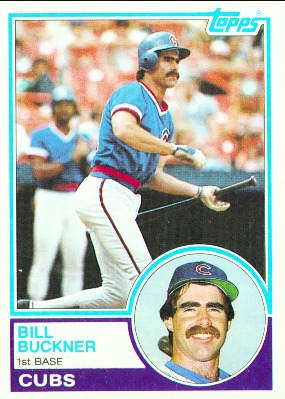
#250 Bill Buckner - Chicago Cubs

I thought I published this post last weekend but somehow I skipped Buckner.  Happy Thanksgiving Everyone!

Bill Buckner looks like he just hit a line drive down the right field line.  The color combo on this card works pretty good on Buckner's 13th Topps card.  I'm pretty sure that is Leon Durham in the background.  He batted behind Buckner 97 times in '82.  Billy Buck sure has some thick eyebrows and mustache!
Player:  A 2nd round pick of the Dodgers in '68, Bill Buckner was promoted to LA in '69 after hitting .322 at three levels but received just one at bat.  Only 20 years old, Buckner started the 1970 season as the Dodgers leftfielder but was sent back down in May with a sub .200 average.  He raked in AAA to the tune of .335 earning him another look in September.
 
Buckner made the Dodgers in '71 as a platoon RF and also saw some action at first base.  He showed great contact ability, striking out just 4% of the time with averages of .277 and .319 and 5 homers each year.  Buckner was a full time player three of the next four years with his average topping .300 in '74 and '76.  He had good wheels early in his career as evidenced by his 31 steals in '74.
 
Before the '77 season, Buckner was sent to the Cubs for Rick Monday.  Buckner shared time his first two years in Chicago before becoming the Cubs everyday first sacker.  From '77 to '83 Buckner hit .301 and hit double digits in the HR column, averaging a dozen a year.  Buckner led the NL in batting average at .324 in 1980 while striking out just 18 times in 615 plate appearances.  
 
While not the prototypical home run clubbing slugger, he topped the Senior Circuit in doubles in '81 and '83.  When this card came out Buckner was coming off a decent season as he drove in over 100 for the first time in '82 and batted .306 with 15 homers.
 
By 1984 Buckner lost his starting job to Leon Durham.  He batted just .209 in his first 21 games and the Cubs sent him to the Red Sox for Dennis Eckersley.  Buckner batted .276 with 11 homers for his new team.  He played in every game in '85 batting .299 with 46, doubles, 16 homers and 110 RBI.  He even swiped 18 bases. 
 
Although his average fell to .267, Buckner hit a career best 18 dingers and drove in over 100 for the third time in his career.  The pennant winning Red Sox dropped the World Series with Buckner labeled as the goat despite the team blowing several opportunities to put the Mets away. 
 
Booed in Boston and razzed on the road, Buckner got out of town when he was released in July of '87.  With his best years behind him, Buckner DH'd part time for the Angels and Royals through the '89 season.  He returned to Boston in 1990 as a pinch hitter and although most of Red Sox nation received him warmly upon his return, the 40 year-old had reached the end of the road and he batted just .186 in 43 at bats.  Great video from ESPN's E:60.
 
Flipside:  Buckner's had one major flaw in his game and that was his lack of base on balls.  He walked only 450 times or 4.4% of his plate appearances and 111 of those were intentional passes. 
After the '82 season Buckner had walked 282 times in his career to 265 strikeouts.  When he returned to Boston in 1990 he had 450 of each before K'ing three times without a walk. 
 
Oddball:  Buckner demanded a trade in '84 when he found out he wouldn't be starting for the Cubs.  According to my 1985 Zander Hollister Handook, a trade with the Phillies fell through when they failed to sweeten Buckner's already robust 5 year-$3.5 million contract.  Billy Bucks blocked the deal and the rest is history.
 
Buckner is one of five players to have played in the 60's and 90's.  The others: Rick Dempsey, Nolan Ryan, Jerry Reuss, and Carlton Fisk.
 
History:  Although his name still conjures up bad memories for a lot of Red Sox fans, time has helped heal wounds caused by Boston's collapse in '86.  He received a long standing ovation from fans when he threw out the first pitch on opening day in 2007 as the Red Sox celebrated their World Series championship the year prior.
Buckner hit over .300 seven times and posted a .289/.321/.408  line for his  career.  He was a hard nosed player who played through pain and had over 2,700 career hits.  

Saturday, October 20, 2012

#230 Fergie Jenkins - Chicago Cubs

Fergie Jenkins deserves better.  At the time this card was released he had pitched in the big leagues since 1965 and amassed 278 career wins.  C'mon Topps, give him an action shot.  He started 34 games in '82 which gave them plenty of opportunity.  This is Jenkins 17th Topps card and he seems perturbed about having to pose with an empty fist in his glove. 
After calling him Fergie on his rookie card, Topps called him Ferguson for six cards before reverting back to Fergie.

Player:  Fergie Jenkins was signed by the Phillies in '62 but pitched only 14 innings in parts of the '65 and '66 season before he was traded to the Cubs.  The 4/21/66 deal sent Jenkins, John Herrnstein, and Adolfo Phillips to the Windy City in exchange for Bob Buhl and Larry Jackson.
 
Jenkins pitched in long relief and made 12 starts with a 3.31 ERA across 182 innings to close out the '66 campaign.  He then had a tremendous six year run of 20-win seasons from '67 to '72.  The best year in the bunch came in 1971.  All he did was complete 30 of his 39 starts and log 325 innings which led the NL.  Jenkins wasn't just eating innings, he K'd 263 batters, walked just 37, posted a 2.77 ERA, and won 24 games along the way.  For his efforts he won the NL Cy Young award.
 
After a 14 win season in '73, the Cubs traded Jenkins to the Rangers for Vic Harris and Bill Madlock.  Fergie had a stellar season for his new club, winning a career best 25 games with a 5 to 1 K/BB ratio.  He had similar stats to his '71 season but this time finished second in the league in CY voting to Catfish Hunter.  Jenkins had a bit of a down year in 1975 but still won 17 games.  His 3.93 ERA was a new high and his 96 ERA+ was the first time his rate had dropped below 101. 
 
The Rangers traded Jenkins to the Red Sox for three players, but he missed the last month of both the '76 and '77 seasons with injuries.  Boston traded him back to Texas and Jenkins stayed healthy and won 46 games over the next three years.  During the 1980 season he was found with drugs at the Toronto airport, suspended by Commissioner bowie Kuhn, but later reinstated by and independent arbiter. 
 
Jenkins struggled through the '81 season, posting a 4.50 ERA, easily the worst of his career.  He signed with Cubs in the offseason and the 39 year-old rebounded with 14 wins, a 3.15 ERA in 217 innings.  Jenkins won only six games in '83 despite making 29 starts and having an ERA that hovered around four all year before settling at 4.30. 
 
Jenkins was released the following spring and retired with a 284-226 record, 3.34 ERA (115 ERA+), and 3192 strikeouts.
 

Flipside:  Tiny stats!  I've mentioned Jenkins' 278 career wins through the '82 season.  According to Bill James' career assessment tool, Jenkins had a 18% chance after the '82 season of reaching 300 career wins.

Fergie JenkinsOddball:  Jenkins played for the Harlem Globetrotters in the offseason from 1967-69.

When looking at his career as a whole, he was not a great hitter (.165 BA), but he had one heck of a '71 season.  He hit .243 with 6 HR and 7 doubles in 115 at bats.


History:  Jenkins never appeared in the postseason despite his long career.   He ranks 23rd all time in WAR among pitchers with 77.4 and seems to be overlooked when discussing all-time great pitchers.  He along with Greg Maddux, Pedro Martinez, and Curt Schilling are the only pitchers with 3,000+ K's and less than 1,000 walks.  Jenkins was elected to the Hall of Fame in '91. 
Be sure to check out the next post featuring Jenkins' Super Veteran Card.

By the way, you can now follow me on Twitter @989baseball.  Besides notifying followers of new posts, I tend to tweet off-the-wall comments and other things about baseball, sports, and life in general.

Sunday, August 5, 2012

#204 Junior Kennedy - Chicago Cubs

Junior Kennedy wanted to play so badly that he often took the field before anyone else was at the ball park and ran the bases.

Ok, all kidding aside, since he isn't wearing a helmet it looks like Kennedy is partaking in a pre-game running drill.  Although no more than 32 years-old when this pic was he is looking more senior than Junior in these pics. 

This is Kennedy's fifth Topps card and you may recall his '79 rookie card in which he dons a plain red helmet.


Player:  Junior Kennedy was a first round pick of the Orioles in 1968 but never made it up to Baltimore.  After the '73 season he was traded to the Reds in the Merv Rettenmund - Ross Grimsley trade.  Kennedy made his major league debut with the Reds in '74 and was mainly used to rest Joe Morgan in late inning blow outs.  He went 3-19 in this role and didn't return to the majors until 1978. 

With Joe Morgan getting older, the Reds kept Kennedy with the big team in '78 and he started 41 games at second base in both '78 and '79.  He batted .255 and .273 and walked about in about ten percent of his plate appearances. Kennedy's lack of any power was his downfall as he slugged under .340 both years.  Even during his good minor league seasons he never had more than 25 extra base hits.

After Morgan left in 1980, Kennedy's role expanded and he started 92 games.  He batted .261/.325/.335 and showed good range at second.  Ron Oester emerged as the starter in '81 and Kennedy played little, knocking 11 hits in 44 at bats. 

Kennedy was sold to the Cubs and they used him semi-regularly in '82.  Batting 271 times in a career best 105 games his average slipped to .219.  By the end of the season Ryne Sandberg had moved from third to second.  Kennedy played just 17 games in '83 and was released in August which turned out to be the end of his career. 


Flipside: Not a lot to say here other than Kennedy's lack of power is evident.  Only 39 XBH's through 1,019 career at bats.

Oddball:  After playing at AAA Indianapolis for four straight seasons Kennedy somehow ended up property of the Giants in '77.   I can't find a record of his transaction going from the Reds to the Giants but it is known that the Reds bought him back after he tore up AAA Fresno at a .316/.408 clip.

History:  Kennedy's career started as an understudy to Joe Morgan and ended backing up Ryne Sandberg, two of the greatest secondbasemen of all time.  Kennedy retired with a .248/.325/.299 line in seven years of action.  He was regarded as a good glove man during his day, which is supported by his 2.6 career dWAR.